
Artificial intelligence has officially entered its hardware era. While algorithms and models have long dominated headlines, the real breakthrough in 2025 belongs to the silicon beneath them. Specialized chips, built for training, running, and customizing AI models, are defining the new age of intelligent computing. Across America, tech giants, startups, and the federal government are racing to keep the U.S. ahead in the high-stakes global competition for AI hardware supremacy.
The Engine Behind the AI Boom
Every chatbot response, image generation, or autonomous navigation relies on finely tuned processors—specifically GPUs, TPUs, and emerging custom chips. These specialized processors handle the massive computational demands of generative AI and multimodal systems. In 2025, AI hardware will have become the critical infrastructure of the digital economy, fueling everything from cloud AI services to edge robotics.
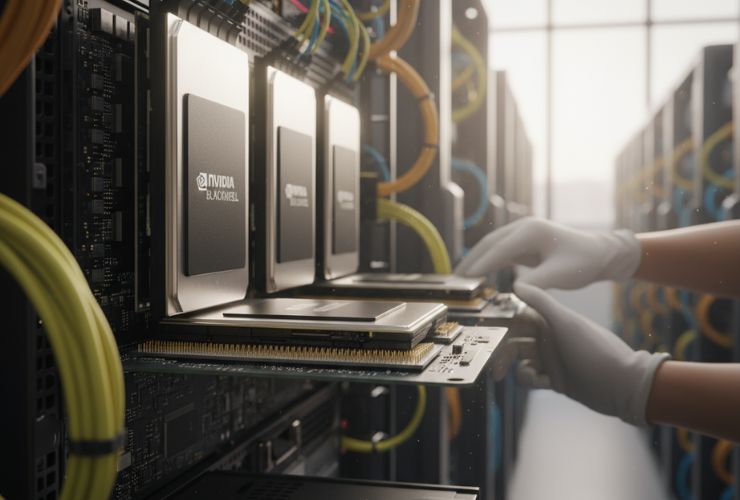
NVIDIA remains the undisputed leader with its H100 Hopper and Blackwell architectures, providing the muscle behind frontier AI models. These GPUs handle trillions of operations per second, translating directly into faster, more cost-efficient training cycles. AMD and Qualcomm, meanwhile, are pushing the envelope with domain-specific chips optimized for robotics and mobile AI applications, proving that innovation extends beyond data centers.
The U.S. vs. China: The New Tech Cold War
At the TED AI 2025 conference, tech visionary Kai-Fu Lee warned of an escalating “hardware cold war” between China and the U.S. As AI models get smarter, the countries producing their chips gain immense geopolitical leverage. Semiconductors have become not just commercial products but national security assets.
President Donald Trump’s administration, aware of this strategic dynamic, has made AI hardware a centerpiece of its technology and foreign trade policy. The Commerce Department has expanded export programs supporting U.S.-made AI components while limiting advanced chip sales to strategic rivals like China. These moves are designed to safeguard domestic innovation while ensuring American technology powers global AI ecosystems.
Innovations Powering the AI Hardware Revolution
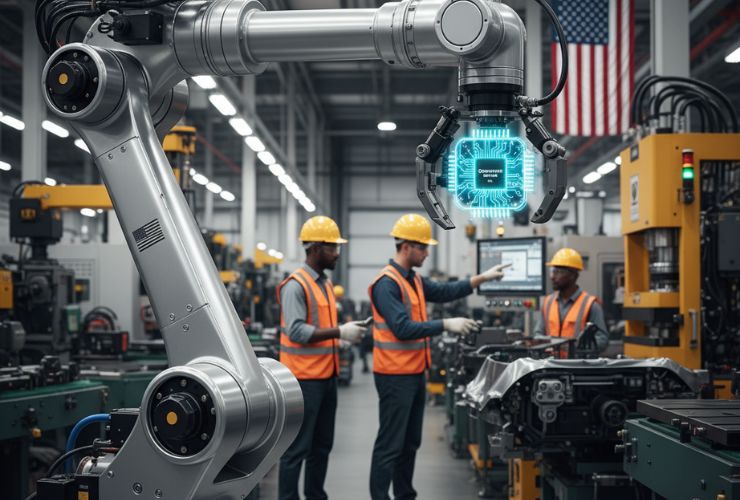
AI hardware innovation isn’t limited to speed—it’s also about intelligence. The newest chips are designed to understand context, optimize power, and even co-design AI algorithms alongside software. Some of the leading advancements seen this year include:
- Multimodal AI Chips: Process images, text, and voice together, enabling devices to interpret diverse data streams seamlessly.
- Energy-Efficient Architectures: Reduce training costs and carbon footprint, paving the way for sustainable AI.
- Robotic Intelligence Platforms: Qualcomm’s new robotics-focused chipsets integrate AI models directly into physical devices, opening new frontiers in smart manufacturing, healthcare, and defense robotics.
These breakthroughs highlight the synergy between AI models and the hardware that powers them. As the two evolve together, future AI systems will be more autonomous, adaptive, and energy-efficient.
Why AI Hardware Is Trending Now
Google Discover and other content discovery platforms are spotlighting AI hardware because it’s reshaping industries in real time. Stock markets are witnessing record highs for hardware firms, while consumers are experiencing the benefits of AI chips in personal technology—from smartphones to smart cars.
What makes this moment unique is the convergence happening across sectors:
- In data centers, hyperscalers like Amazon, Microsoft, and Meta are customizing NVIDIA and AMD chips for their proprietary AI clouds.
- In edge computing, startups are deploying AI-specific SoCs (systems-on-a-chip) that deliver local intelligence without relying on massive cloud servers.
- In automotive technology, companies such as Tesla and Cruise leverage AI hardware for safer real-time navigation and adaptive vehicle behavior.
This pervasive integration shows that AI hardware isn’t confined to labs—it’s the foundation of our emerging smart economy.
The Software-Hardware Synergy
The next wave of AI progress will emerge from tight co-design between software engineers and hardware architects. In 2025, leading AI firms are designing chips and models in tandem, allowing for unprecedented optimization. Large language models (LLMs) are being fine-tuned to run efficiently on specific architectures, reducing the sheer compute required for inference and training.
OpenAI and Google DeepMind exemplify this trend: their latest incremental models are built directly on chip-aware frameworks, unlike the one-size-fits-all training of earlier years. This co-innovation accelerates performance while lowering energy consumption—critical for scaling AI responsibly.
U.S. Government and Private Sector Collaboration

The Trump administration’s policy to support AI hardware export competitiveness has catalyzed new public-private partnerships. Federal agencies, national labs, and chipmakers now collaborate on fostering innovation ecosystems centered around semiconductor research, workforce training, and manufacturing capacity.
One highlight is the AI Hardware Innovation Challenge, a Department of Commerce initiative that funds startups exploring new architectures like neuromorphic processors and quantum-AI hybrids. These next-generation chips could redefine how machines perceive and process the world, blurring the boundary between computation and cognition.
Startups Fueling Disruption
Beyond established players, nimble startups are powering much of America’s innovation momentum:
- Cerebras Systems has introduced wafer-scale chips dedicated entirely to AI workloads, drastically reducing training time.
- Tenstorrent, backed by American and international investors, blends RISC-V design philosophy with AI-specific compute blocks.
- Groq is pursuing deterministic AI processing, enabling predictable latency critical for real-time systems.
These new entrants reflect Silicon Valley’s continued dynamism, demonstrating that the AI hardware frontier remains open to ambitious innovators.
The Future: Intelligent Hardware Everywhere
Looking ahead to 2026 and beyond, AI hardware will extend beyond traditional computing contexts. The fusion of chips, sensors, and AI models will make physical devices—from drones to home appliances—function as semi-autonomous systems. “Smart everything” will no longer be a buzzword but a lived reality of U.S. manufacturing and consumer technology.
As these trends unfold, the distinction between hardware and AI will vanish. Your phone’s processor will actively learn, your car’s sensors will adapt to new conditions, and cloud AI will retrain models on the fly. The key driver behind all this intelligent evolution? American-made silicon is at the heart of global innovation.
Final Thoughts: America’s AI Hardware Moment
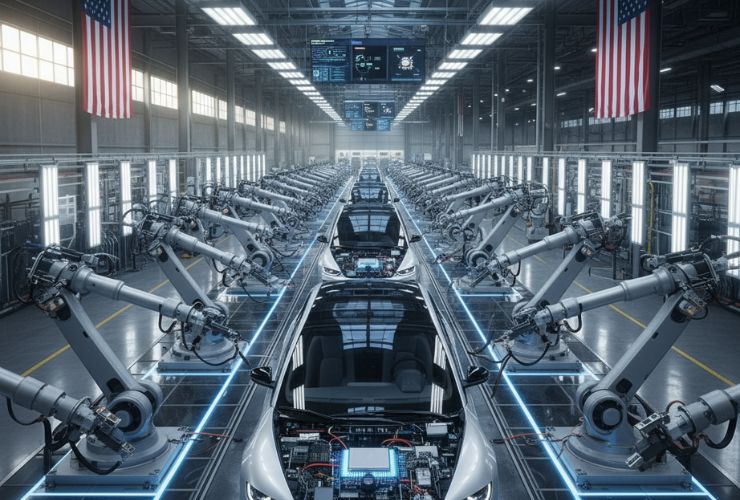
AI hardware stands at the intersection of national strategy, entrepreneurship, and technological revolution. The United States, with its unmatched ecosystem of chip designers, software pioneers, and supportive policy frameworks, is positioned to maintain a decisive lead in this global race.
For creators, engineers, investors, and policymakers, 2025 represents a historic inflection point. The next frontier of AI will be built not just on smarter models—but on the extraordinary chips that make intelligence tangible.